

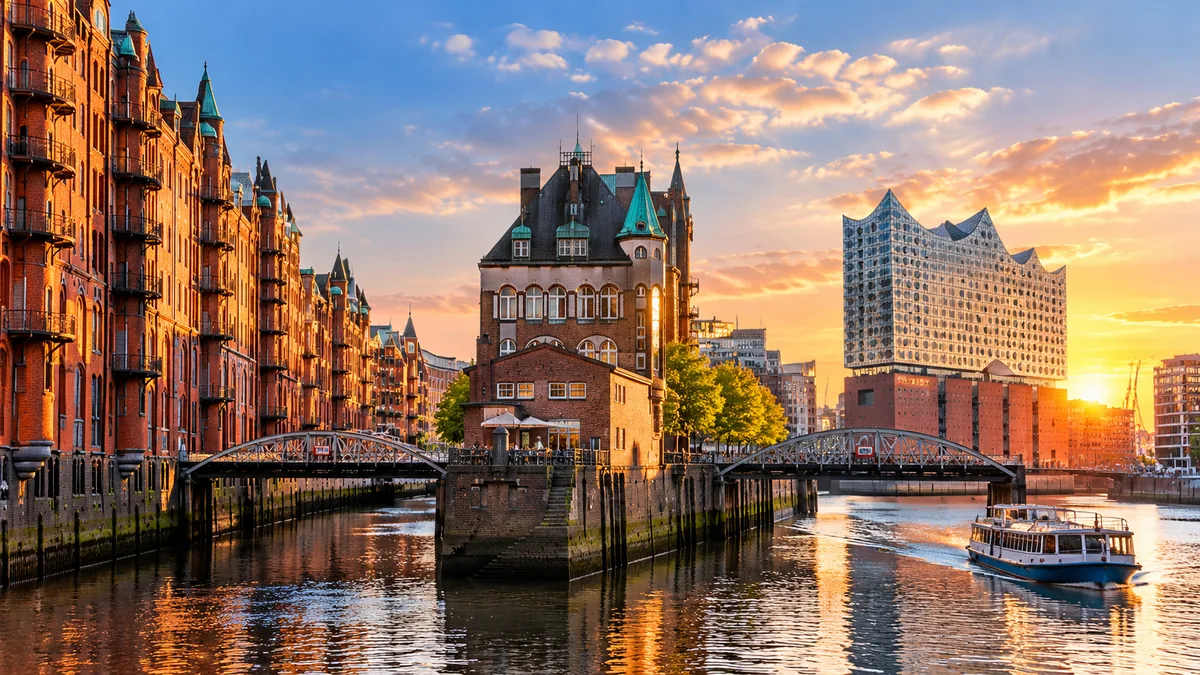
Hamburg is Germany’s second-largest city and one of Europe’s most distinctive city-break destinations. With historic canals, red-brick warehouses, striking modern architecture, lively neighbourhoods and a strong maritime character, there’s plenty to discover whether you’re visiting for a weekend or staying a little longer.
From the UNESCO-listed Speicherstadt and grand Rathaus to St Pauli’s music history and the modern Elbphilharmonie, here are some of the highlights worth adding to your Hamburg itinerary.
Explore Hamburg’s Canals and Waterfront
Hamburg’s identity has been shaped by water for centuries. The city sits on the River Elbe and is threaded with canals, lakes and waterways that connect its historic trading districts with the modern harbour.
Hamburg is also famous for its bridges. According to the city’s official visitor information, it has more than 2,300 — more than Venice and Amsterdam combined.
A good way to explore: wander the waterfront on foot, take a harbour or canal cruise, or simply follow the bridges between the historic centre, Speicherstadt and HafenCity.
For current visitor information and ideas, see the official Hamburg visitor website.
Discover Speicherstadt
One of Hamburg’s most recognisable areas is Speicherstadt, the historic warehouse district built across a network of narrow islands and canals.
Its rows of red-brick warehouses were developed largely between 1885 and 1927, with parts rebuilt after the Second World War. Together with the neighbouring Kontorhaus District and Chilehaus, Speicherstadt was added to the UNESCO World Heritage List in 2015.
Historic warehouses
Explore the distinctive red-brick buildings that once played a central role in Hamburg’s international trade.
Canals and bridges
Footbridges and waterside paths make this one of Hamburg’s most atmospheric areas to explore on foot.
Old meets new
The warehouse district sits alongside HafenCity and the Elbphilharmonie, creating one of the city’s most striking contrasts.
Find out more about Speicherstadt and the Kontorhaus District on the UNESCO World Heritage website.
Visit Hamburg City Hall
Hamburg’s impressive Rathaus sits at the heart of the city on Rathausmarkt and remains the seat of Hamburg’s parliament, senate and mayor.
Construction began in 1886 and the neo-Renaissance building opened in 1897 after 11 years of work. Today, visitors can admire its elaborate façade, courtyard and richly decorated interiors, with guided tours available at certain times.
You can check current visiting information on the official Hamburg City Hall guide.
See the St Nikolai Memorial
The ruins of St Nikolai offer a very different perspective on Hamburg’s history.
The church was rebuilt after the Great Fire of 1842, and when its 147.4-metre spire was completed in 1874 it briefly became the tallest building in the world.
Much of the church was destroyed during the bombing of Hamburg in 1943. Today, the surviving ruins form a memorial and museum dedicated to the destruction of war and its victims.
For city views: a glass lift takes visitors to a viewing platform around 76 metres above the city.
Check current opening information for the St Nikolai Memorial.
Climb St Petri Church
St Petri is Hamburg’s oldest church and sits only a short walk from Rathaus.
The church has been rebuilt during its long history, including after the Great Fire of 1842, but remains one of the city centre’s most important landmarks.
Visitors willing to tackle the tower stairs can reach a high viewing platform with panoramic views across central Hamburg, the Alster lakes and towards the port.
Opening arrangements can change, so check the latest visitor information for St Petri before you go.
Follow in the Beatles’ Footsteps in St Pauli
Hamburg played an important role in the early story of the Beatles. Between 1960 and 1962, the young band spent long periods performing in St Pauli’s clubs before becoming internationally famous.
Their early Hamburg venues included the Indra and Kaiserkeller around Große Freiheit, close to the Reeperbahn.
Beatles fans: look out for Beatles-Platz and the plaques and surviving venues around St Pauli that mark the band’s time in Hamburg.
Explore the story in more detail with the official Hamburg Beatles guide.
Experience St Pauli and the Reeperbahn
For nightlife, live music and a completely different side of the city, head towards St Pauli and the Reeperbahn.
The district has a long history as an entertainment and red-light area and remains home to adult venues, but it is also one of Hamburg’s main centres for live music, theatre, bars, clubs and late-night entertainment.
If nightlife isn’t your thing, St Pauli is still worth exploring for its music history, street art and distinctive neighbourhood atmosphere.
Discover Modern Hamburg
Hamburg isn’t only about historic warehouses and churches. Some of the city’s best-known attractions show its more modern side.
Elbphilharmonie
Hamburg’s landmark concert hall combines a modern glass structure with a historic warehouse base on the waterfront.
Planten un Blomen
A large central park with gardens, paths and plenty of space for a quieter break from sightseeing.
City-centre shopping
From Neuer Wall to Mönckebergstraße, Hamburg offers everything from luxury boutiques to familiar high-street names.
If you’re interested in the concert hall, check the Elbphilharmonie visitor information before travelling.
What Food Should You Try in Hamburg?
Hamburg’s maritime history is reflected in its food, but there are also plenty of local sweet treats worth trying.
Fischbrötchen
A simple fish sandwich and a classic harbour-side snack.
Labskaus
A traditional northern German dish associated with Hamburg’s maritime history.
Franzbrötchen
A sweet, cinnamon-flavoured pastry that you’ll find in bakeries across the city.
Hamburg Travel Tips
✓ Getting around
Hamburg has an extensive U-Bahn, S-Bahn, bus and ferry network, making it easy to explore without a car.
✓ Pack for changeable weather
Hamburg’s northern location and maritime climate mean conditions can change quickly, so layers and a waterproof are useful.
✓ Wear comfortable shoes
Many of the central attractions are easy to combine on foot, especially around Rathaus, Speicherstadt and HafenCity.
✓ Check opening times
Opening hours, tour availability and ticket arrangements can change, so check official attraction websites before visiting.
Do You Need Travel Insurance for Hamburg?
Whether you’re visiting Hamburg for a weekend city break or including it as part of a longer European trip, it’s worth considering travel insurance before you go.
Depending on the policy and cover level selected, travel insurance may provide benefits for things such as emergency medical expenses, cancellation, baggage and certain travel disruption.
If you have pre-existing medical conditions or plan to take part in particular sports or activities, check the relevant policy requirements before travelling.
You can find out more about Covered2Go Europe Travel Insurance.
Planning a Trip to Hamburg?
Compare Covered2Go travel insurance options and choose cover that suits your European city break.
Cover is subject to eligibility, benefit limits, excesses, terms, conditions and exclusions. Please read the Policy Wording carefully to ensure the cover meets your needs.